Libyan “torturer” brought to The Hague for crimes against humanity

A former Libyan prison guard has been handed over to the International Criminal Court (ICC) in The Hague following his arrest in Germany on July 16th this year. As first reported in The Libya Gazette, Khaled Mohamed Ali El Hishri was a prison guard at the Mitiga Prison in Tripoli, a prison that, as of 2024, was still in use according to the Global Detention Project. El Hishri is suspected of “having committed directly himself, ordered or overseen crimes against humanity and war crimes, including murder, torture, rape and sexual violence, allegedly committed in Libya from February 2015 to early 2020”, according to the ICC.
The official transcript of charges from the ICC against El Hishri is: “War crimes: cruel treatment, torture, outrages upon personal dignity, rape, sexual violence and murder of a number of persons detained in Mitiga Prison; and crimes against humanity: imprisonment, committed by imprisoning detainees in Mitiga Prison without a legal basis to do so; torture, rape, sexual violence and murder of a number of persons during their detention in Mitiga Prison; and persecution by targeting detainees of Mitiga on the basis of, inter alia, their views.”
The trial of El Hishri will be of significance, demonstrating that crimes of the highest order committed in Libyan detention centres are subject to international scrutiny and can eventually lead to prosecution and imprisonment. Such scrutiny has been made more possible due to the fact that on 12th May 2025, Libyan authorities accepted the ICC’s jurisdiction over its territory. The initial decision to open an investigation into crimes in detention centres in Libya was made by the ICC along with the United Nations Security Council on March 3rd 2011, but despite the 14-year wait for Libyan cooperation, the ICC now holds permission until 2027.

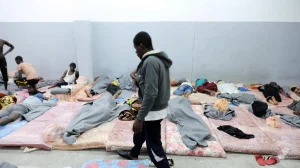
Despite El Hishri being held in custody, the ICC still holds warrants for the arrest of nine others involved in alleged abuses in Libya. His arrest is a start, however and could represent a progressive shift toward a more accountable Libya in the coming years. Detention centres across Libya remain places where crimes against humanity continue. According to the Global Detention Project: “Libya is notoriously perilous for refugees and migrants, who often suffer a litany of abuses, including at the country’s numerous detention facilities. Conditions at these facilities, many of which are under the control of militias, are deplorable. There are frequent shortages of water and food; over-crowding is endemic; detainees can experience physical mistreatment and torture; forced labour and slavery are rife; and there is a stark absence of oversight.”
As of 2024 it was reported that over 200,000 refugees were held in Libya. However conflicts in Sudan and the Democratic Republic of Congo mean that the figure is likely now far higher. Libya remains one of the worst countries in the world to be held as a refugee. Forced deportations, human traffickers and abusive detention centres, such as Mitiga where El Hishri is facing charges of crimes against humanity, all pose significant threats to the rights and lives of refugees held in Libya.
The ICC is yet to set a date for the trial of El Hishri however: “A hearing will be scheduled in due course for Mr El Hishri’s initial appearance before the Court. During this hearing, the Chamber will confirm the identity of the suspect and the language in which Mr El Hishri is able to follow the proceedings. The Chamber will also satisfy itself that Mr El Hishri has been informed of the crimes which he is alleged to have committed, and of his rights under the Rome Statute.”
The Libya Gazette/ Global Detention Project/ ICC
Want to chase the pulse of North Africa?
Subscribe to receive our FREE weekly PDF magazine