Hafed Al-Ghwell: Libya’s war on women


Libya’s woes are often described in terms of armed factions, oil, kleptocracy, and the collapse of governance. Yet one of the country’s deepest fractures is not the lost barrels of crude or warring brigades. It is measured in the bodies of women. Libya has, in effect, waged a quiet but devastating war on women, characterized by unchecked killings, the normalization of abuse, and institutions hollowed out to the point where protection is more fiction than function.
To understand why women in the country bear the brunt of the slow-motion collapse of the state, one must begin with an understanding of the basic structure of Libyan governance. Or, more accurately, its absence.
Two rival governments, both of which claim legitimacy while neither offers any real security, have created a vacuum in which affiliated armed groups rule by force rather than law. With militias embedded within ministries, the “police” compromised, and the courts incapable of enforcing rulings, impunity is woven into the fabric of everyday life.
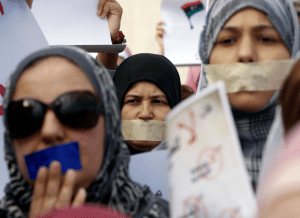

It is within this context that femicide and gender-based violence have flourished. The data, though incomplete, points to a chronic and escalating crisis. Within a week of a recent UN campaign on violence against women there were three high-profile murders in Libya: a social media influencer shot in her car, a doctor killed by relatives, and the body of an unidentified woman dumped outside Tripoli.
Worse yet, many cases never become public knowledge because most killings happen at home, often committed by husbands linked to armed groups or carrying trauma from years of conflict. Such violence is not confined to domestic spaces, however. Migrants, Christian minorities, and other vulnerable groups face conditions that amount to blatant predation.
More than 14,000 migrants were intercepted and returned to Libya in mid-2025 alone, over a thousand women among them. They were detained in facilities run by militias or traffickers masquerading as state agents. Reports regularly document the systemic abuse, torture, and exploitation that happens in those detention facilities.
Even the recent rescue of 11 kidnapped migrant women by military units reveals an uncomfortable reality: When the same actors responsible for enforcing “security” are sometimes complicit in abuses, safety becomes a lottery.
Another underlying ill is the endurance of a social contract that treats the autonomy of women as negotiable. The legal framework in Libya still fails to criminalize domestic violence, spousal abuse, or sexual harassment.
Even the act of reporting gender-based violence risks prosecution for victims. A draft law recognizing all forms of violence against women has been in limbo since 2023. And a ban on the word “gender” in official policies reflects a political culture that treats equality as a threat, rather than a constitutional commitment.
Libyan society finds itself in a strange “protector-perpetrator” paradox. Basically, social norms in the country task male guardians with safeguarding women. In practice, however, the men who are supposed to provide the protection are often those who inflict the most harm.
Throughout Tripoli, Benghazi, and Sabha, for example, women are forced to rely on male guardians for mobility, financial security, and social legitimacy. This dependency creates conditions in which control easily mutates into abuse — or worse. Many women describe such enforced guardianship as a trap: a system in which protection is conditional on obedience, and disobedience invites punishment.
The political economy of violence worsens the situation. Armed groups, flush with state funds through networks of patronage, wield both resources and the power of coercion. Some women even marry militia members simply to avoid harassment at checkpoints, a survival strategy that paradoxically places them at even higher risk of violence, at home.
Libya’s war on women is, ultimately, a war on its own future.
The paralysis of governance in Libya has amplified ideological policing. In the east of the country, authorities endorse gender segregation and restrictions on the mobility of women. In the west, morality policing has resulted in the arrest of women on vague charges such as hosting “mixed gatherings.”
The retreat of the state has allowed other actors, both official and unofficial, to selectively impose draconian norms, heightening the pressure on women to self-censor and completely withdraw from public life.
Online violence has surged as well, turning social media into yet another arena of intimidation; election monitors documented an 89 percent increase in such attacks on women this year.
In such a climate, political participation becomes an act of personal risk. High-profile assassinations — such as those of rights activists Salwa Bugaighis in 2014, Hanan Al-Barassi in 2020, among others — have had a chilling effect. Each killing sends the same message: women who speak out are fair game.
But the consequences extend beyond individual tragedy: Libya’s war on women corrodes state-building as well. The exclusion of women from public life reduces political competition, stunts civic debate, and removes essential actors from critical peace processes.
Decades of research into post-conflict governance have shown that states with higher levels of gender inclusion are more stable, more democratic, and less prone to relapse into violence.
Libya, in contrast, has reversed even the limited gains it made after 2011. In effect, the women who helped ignite the revolution now find themselves pushed to the margins of the very system they hoped to reshape.
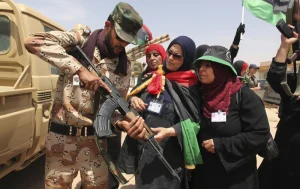
There is also an economic cost. When half of a country’s population is constrained by fear, harassment or mobility restrictions, productivity drops, labor markets contract, and household vulnerabilities deepen.
Moreover, Libya’s stalled diversification efforts, a youth unemployment crisis, and its shrinking civic space are all linked to this degradation of women’s rights. A society that fails to criminalize, or even merely tolerates, violence against women is a society that burns its own social capital. This is precisely why the treatment of women should not be relegated to the periphery, it should be a diagnostic tool — a litmus test for whether Libya can sustainably rebuild itself.
After all, a country that cannot protect women cannot stabilize. A state that allows militias to terrorize women cannot govern. And a political class that refuses to enact basic protections for women cannot claim legitimacy.
Libya needs functioning institutions that are capable of enforcing the law, not simply mimicking it. It needs courts that treat violence against women as a crime, not a family matter. It needs a political compact that commits to equality, not as a concession to foreign patrons but as the foundation for a stable state. Most importantly, it needs to reimagine the very idea of protection, shifting from a guardian-centric model to a citizenship-based system in which rights are inherent, not negotiated.
READ: Zaid M. Belbagi: Why water security defines MENA’s future
Libya’s war on women is, ultimately, a war on its own future. No road map for elections, ceasefire agreement or constitutional committee will succeed if half of the population remains confined, silenced, or brutalized.
The ultimate measure of Libya’s reemergence will be whether women can drive without fear, speak without threats, and live without bargaining for protection. Until then, Libya remains a country fighting the wrong battles — and losing the most important one.
The views expressed in this article belong to the author and do not necessarily reflect the editorial policy of Maghrebi.org. Hafed Al-Ghwell is a senior fellow and executive director of the North Africa Initiative at the Foreign Policy Institute of the Johns Hopkins University School of Advanced International Studies in Washington, DC. X: @HafedAlGhwell.
If you wish to pitch an opinion piece, please send your article to grace.sharp@maghrebi.org.

Want to chase the pulse of North Africa?
Subscribe to receive our FREE weekly PDF magazine