Pumped hydropower storage is making a comeback
RheEnergise’s demonstration plant is located in the southwest of England. PHOTOGRAPH: RHEENERGISE
Old and new pumped hydro projects are expanding worldwide to store renewable energy and stabilise electricity grids, as reported by Wired on 18 December.
Pumped hydro energy storage, a long-established technology that balances electricity supply and demand, is experiencing a global resurgence as countries and companies look for ways to stabilise grids fed by variable renewable energy like wind and solar.
In Devon, England, engineers have been mixing a dense, mineral-based fluid at a former china clay mine to test a new variation of pumped hydro storage. When released down pipes to a lower container, this fluid drives turbines and generates electricity. The process can be reversed by pumping the fluid back up when there is excess power on the grid, storing energy for later use.

Stephen Crosher, chief executive and co-founder of British energy storage firm RheEnergise, said, “It’s quite a hands-on process. At bigger scales, we would automate it.”
RheEnergise’s demonstration system has already produced power, and the company says a 10-megawatt commercial project could follow by 2028 if tests continue to succeed. The ‘denser than water’ fluid allows the system to operate in smaller, lower-elevation sites compared with traditional water-only pumped hydro facilities.
Industry groups see this innovation as part of a much larger trend. Rebecca Ellis, senior energy policy manager at the International Hydropower Association [IHA], described the moment as “a really exciting time.”
The IHA estimates that about 600 gigawatts of pumped hydro projects are in the global pipeline, with 8.4 GW installed in 2024 alone. One recent major addition was the 3.6 GW pumped hydro plant in Fengning, China, now the world’s largest in terms of capacity.
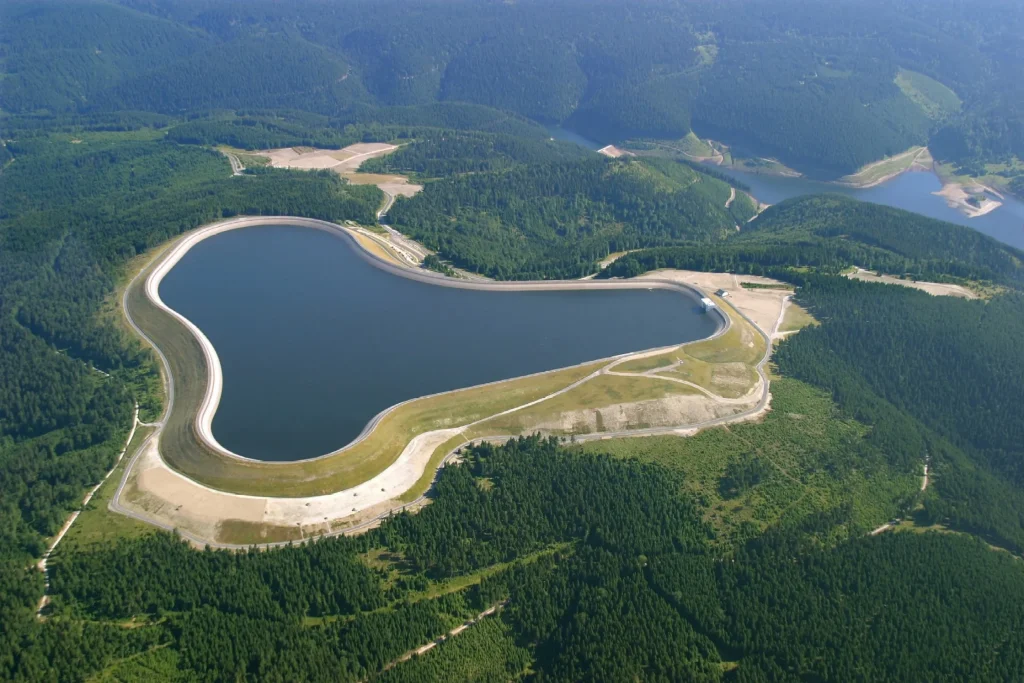
Traditional pumped hydro remains essential to energy systems. In Germany, the Goldisthal facility links reservoirs with 800-metre-long penstocks and can switch from idle to full generation in around 90 seconds, producing more than a gigawatt of power for several hours when needed. Operators there use algorithms to decide when to generate and when to pump, responding to changes in grid demand and renewable output.
Despite its promise, pumped hydro is not without challenges. Large projects such as Australia’s Snowy 2.0 expansion, which will deliver about 350 GWh of storage when complete, have faced delays, cost overruns, and construction issues.
Supporters argue that both traditional and innovative pumped hydro technologies are vital for the energy transition. “If you want solutions for the climate emergency and the energy transition, then [traditional] pumped hydro will do part of it, but they’re too slow to do it all,” Crosher said, underscoring the need for faster, more flexible storage solutions.
As renewable generation grows worldwide, pumped hydro, new and old, could play a central role in balancing power systems and reducing reliance on fossil fuels.
Wired and Maghreb.org
Want to chase the pulse of North Africa?
Subscribe to receive our FREE weekly PDF magazine