Simon Waldman: The cost of importing foreign conflict
I am dumbfounded by how anyone living in Europe, Australia, or North America can be so irresponsible as to call for the globalisation of a foreign conflict. Surely globalising any conflict whether it is Cyprus, Kashmir, or Israel-Palestine is a recipe for inter-communal tension. Want to live peacefully in a multicultural society? Don’t globalise overseas wars.
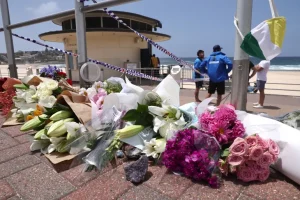
Whether those who utter it realise it or not, attacks against Jews outside of Israel or other forms of violence is the essence of what it means to “Globalize the Intifada”. We saw that on December 14th, with the father-son shooting rampage in Sydney that left 15 Hanukkah party goers dead.
In the UK, the Metropolitan Police announced that protesters may be arrested if they shout, “Globalize the Intifada”, as the “context has changed.” I don’t think the context has changed. Whether protesters realise it or not, the slogan was and still remains a call for attacks against Jews.
In the wake of the Sydney shootings (and also the previous Manchester synagogue attack and the murders in Washington DC) several observers both in the mainstream press and social media openly declared that this is what globalizing the intifada looks like to the chagrin of demonstrators who support the phrase.
Some insist that “globalize the intifada” is a call for global solidarity with the Palestinian people and their cause and is not a call to attack Jewish targets. Some add that there were two Palestinian intifadas. The second was violent, but the first (1987-1991) was more about civil disobedience and non-violent protest.
Those who claim that “Globalize the Intifada” is an expression of international solidarity are being disingenuous. “Intifada” is not the term adopted by Palestinians to describe their struggle against Israel. Other terms are often employed such as muqawama, meaning resistance (usually armed but also unarmed) or samud (steadfastness) when trying to endure the more day-to-day difficulties of the Israeli occupation. The word “Intifada,” which can mean uprising or rebellion in Arabic, is understood and referred to by Palestinians as a specific type of uprising against Israel of which there have been two.
I first heard “Globalize the Intifada” back in 2001 at a protest in London, just as the second Intifada (2000-2005) was at its height, and suicide bombers were detonating in crowded Israeli cities. The second Intifada consisted of hundreds of lethal suicide attacks and shootings. It was a highly violent event that tore to pieces the Oslo Peace Accords which were already on the rocks. Referring to this intifada is a call to violence.
The first Palestinian Intifada that started in December 1987 was also violent. I have heard activists depicting it as an uprising primarily consisting of strikes and non-violent protest. This attempt to re-write or whitewash the uprising’s bloody nature is something I plan to turn to in a later post as it represents a deliberate attempt to distort reality.
Want to live peacefully in a multicultural society? Don’t globalise overseas wars.
The First Intifada was never non-violent. However, during the early stages, there was an attempt by some activists to engage in non-lethal violence against Israel and its occupation of the West Bank and Gaza Strip. However, non-lethal violence is not the same as non-violence and soon the Intifada become deadly with not just strikes, marches, and protests, but also mass stone and Molotov cocktail throwing (sometimes gun and grenade attacks, too).
Also, the first Palestinian suicide attack was committed during the height of the first Intifada when, in 1989, a Palestinian Islamic Jihad operative grabbed the wheel of the 405 bus from Jerusalem to Tel Aviv, running the vehicle off a cliff, killing 16 passengers. I actually remember the incident from when I was a young kid. My Dad was watching the news with his mouth agape, shaking his head and then switched it off after he noticed I was staring at the remains of a wrecked bus surrounded by the meshed orange and yellow hues of the desert landscape.
READ: Dr. Azeem Ibrahim: The normalisation of global displacement
What was also ominous about the first intifada is the nature of some of the Palestinian casualties. Israel’s actions towards Palestinian activists, violent or otherwise, was certainly heavy handed. However, what is less remembered is that towards the end of the intifada from around 1991 onwards, there were many killings of Palestinians by Palestinian factions – executions of those considered collaborators with Israel. Arguably, this was an extra-judicial settling of scores not unlike Hamas’ murders of so-called collaborators after the recent ceasefire in Gaza.
So that slogan, “Globalise the Intifada” is indeed a call to violence.
I suggest to those who do not wish to advocate violence against Jews or moderates yet wish to express global non-violent solidarity with the Palestinian cause adopt a different slogan.
The views expressed in this article belong to the author and do not necessarily reflect the editorial policy of Maghrebi.org. Dr Simon A. Waldman is a Teacher in the Defence Studies Department. Simon is the author of Anglo–American Diplomacy and the Palestinian Refugee Problem and the co-author of The New Turkey and its Discontents (Hurst and Oxford University Press, 2017).
If you wish to pitch an opinion piece, please send your article to grace.sharp@maghrebi.org
Want to chase the pulse of North Africa?
Subscribe to receive our FREE weekly PDF magazine