Google denies altering maps after Western Sahara border vanishes
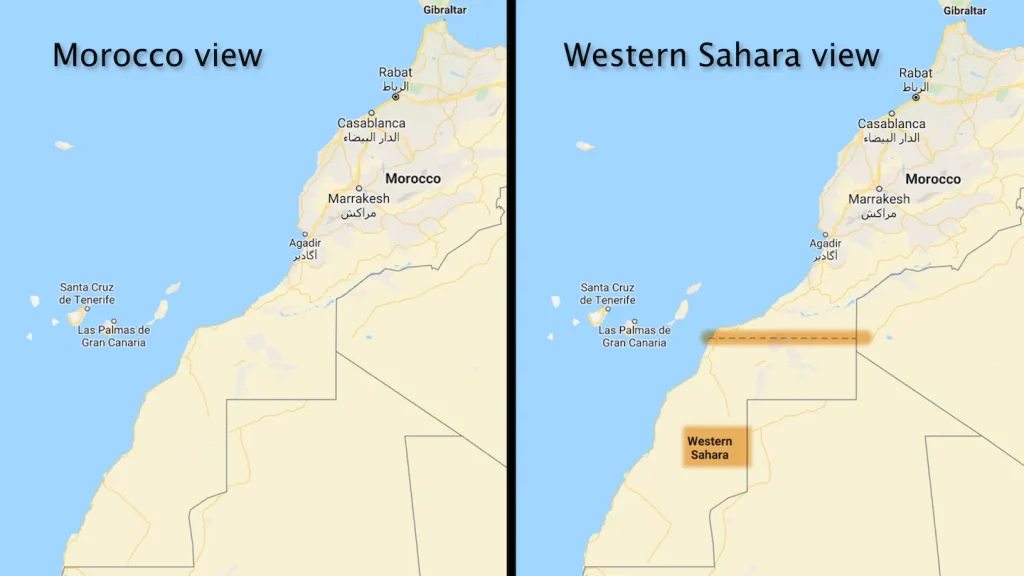
Google Maps showing Morocco and Western Sahara differently according to the region where it is viewed. (via Washington Post)

Google clarified that it did not alter any borders on its Google Maps between the disputed Western Sahara and Morocco after the recent resolution 2797 passed at the UN Security Council, according to The New Arab via AFP on 12th November.
Last week, media reports alleged that Google Maps had removed the dotted line border between Western Sahara and the Moroccan state following the UN’s endorsement of Morocco’s autonomy over Western Sahara as the most feasible option.
“We have not made changes to Morocco or Western Sahara on Google Maps,” said the Google spokesperson.
“These labels follow our longstanding policies for disputed regions. People using Maps outside of Morocco see Western Sahara and a dotted line to represent its disputed border; people using Maps in Morocco do not see Western Sahara,” they said.
Google has said previously that its goal is to remain neutral in disputed regions and to display them with a grey dotted line when appropriate. But Google also takes into account the local laws and conventions and tries to display accordingly. This means Google Maps changes its display according to the location of the user who is viewing it.
Google reportedly has a special team referred to as “the disputed region team” that addresses such matters. According to The Washington Post, Google’s choices about how to draw the Maps are often kept secret, even from some employees who work on Maps.
They said that these decisions are not just based on history and local laws, but can be shaped by pressure from governments, diplomats, and Google’s top executives.
The resolution passed by the UN on October 31st serves as a framework for Morocco, the Algeria-backed Polisario Front, and Mauritania to reach a broader agreement.
However, with many countries including the Trump administration in the United States expressing support for Morocco’s autonomy proposal, the balance of international backing appears to favour Rabat. Meanwhile, the Polisario Front continues to reject Morocco’s plan and insists on holding a referendum.
The New Arab via AFP, The Washington Post, Maghrebi.org
Want to chase the pulse of North Africa?
Subscribe to receive our FREE weekly PDF magazine