Libya has the third highest unemployment rate in the Arab world
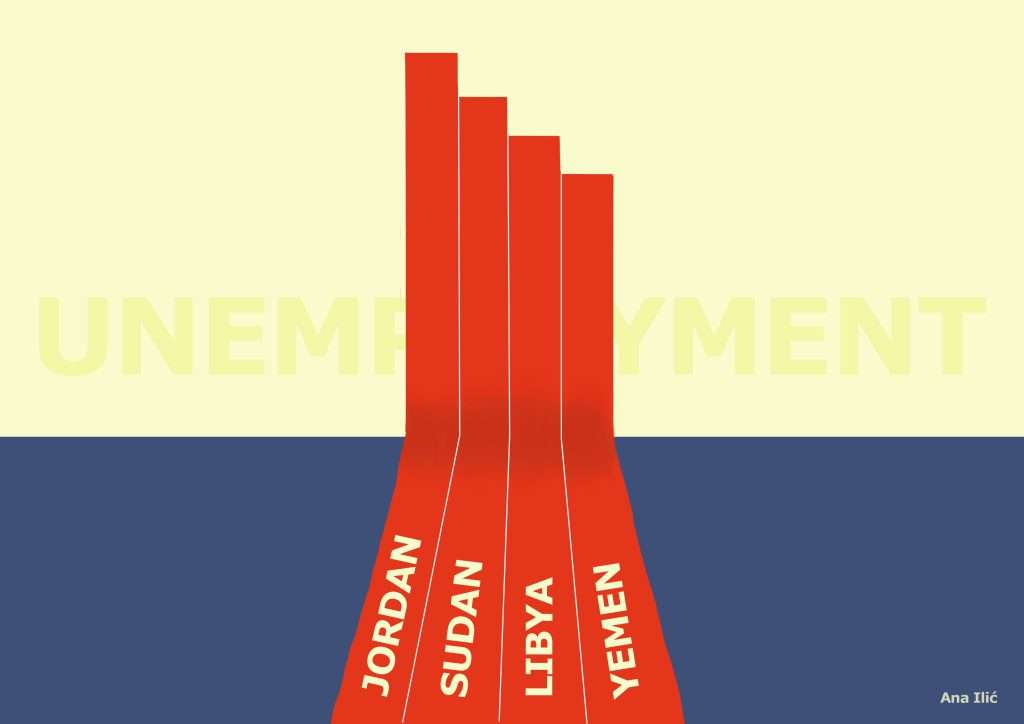

Libya now has one of the highest unemployment rates in the Arab world, with only Jordan and Sudan worse off in 2025, according to the Libya Review on December 3rd.
New regional economic indicators were published by Trading Economics, which illustrated the scale of Libya’s labour market stagnation among other gauges of the national economy’s well-being.
The new data revealed that Jordan has the highest regional unemployment rate at 21.3%, followed by Sudan at 20.8% and Libya at third with 18.6%, which is a marginal improvement of -0.1% from last year’s figure. Yemen closely trailed in fourth place with a 17.1% unemployment rate.

The Arab world has long had to grapple with a struggling labour market. In 2022, the UN Economic and Social Commission for Western Asia (UNESCWA) published a survey which found that “the Arab region registered the world’s highest unemployment rate… at 12%.”
The recent figures highlight the constant pressure on labour markets in the region due to several factors, such as political instability, conflict, economic volatility, and inadequate job creation in both the public and private sectors.
More specifically, Trading Economics assessed the root causes of the high unemployment rate to be structural weakness in the national economy, erratic and inconsistent economic policies, and an absence of proactivity in development programmes.
Libya has shown some degree of initiative in tackling the latter issue. In late September 2025, the Ministry of Economy and Trade announced the launch of a new development scheme designed to tackle youth unemployment by strengthening the nation’s nascent private sector.
Entitled the “Entrepreneurs Skills and Solutions Project”, the scheme offers targeted training for Libya’s youth that focuses on equipping them with practical skills, as well as aligning their education with labour market demands to create a more coherent link between academia and employability.
The scheme was launched in the wake of a persisting youth unemployment crisis in the country. As of January 2025, roughly 51% of Libya’s youth, 1.1 million people, were unemployed.
Furthermore, Libya’s rampant institutional corruption, predominantly oriented around illicit fuel smuggling out of the country, has simultaneously deterred foreign investment and stifled public spending on ailing sectors such as healthcare and education.
Libya Review, Trading economics, UNESCWA, Maghrebi.org

Want to chase the pulse of North Africa?
Subscribe to receive our FREE weekly PDF magazine