Israel’s white phosphorus use leaves lasting danger in Lebanon
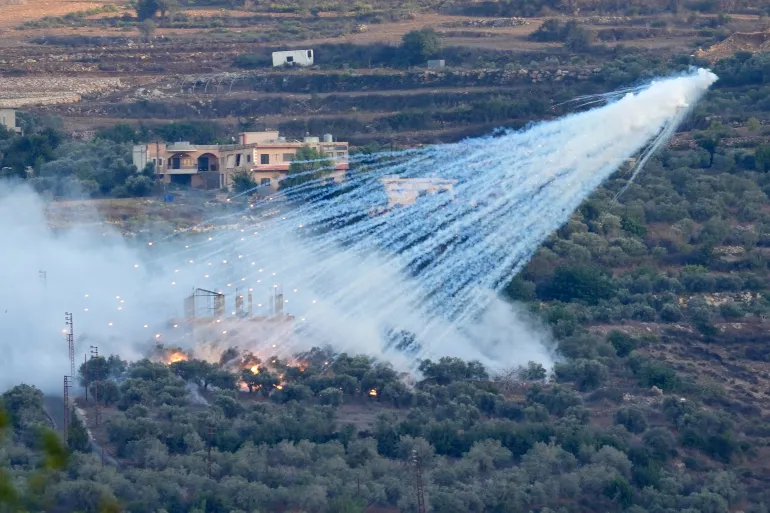
People in the south are worried about eating food crops contaminated by white phosphorus. Shown here is an explosion over al-Bustan, near the border. [Hussein Malla/AP Photo]

A new study warned that thousands of white phosphorus fragments left by Israeli strikes continue to threaten civilians and farmland in southern Lebanon, reported France 24 on December 3rd.
The research, revealed that white phosphorus shells fired by Israeli forces between October 2023 and November 2024 left thousands of hazardous fragments scattered across southern Lebanese villages — many of which remain dangerous today.
Open source intelligence (OSINT) researcher at Delft University of Technology in the Netherlands, Ahmad Baydoun, said: “The munitions explode in the air and produce 115 small fragments that sink into the ground and continue to emit this toxic substance for ten to fifteen minutes. Fragments can remain active in the ground. They can remain dormant until they are exposed to oxygen again. Then they reactivate and produce smoke.”
The study estimates that nearly 28,700 fragments have contaminated the region, making them “very difficult to extract.” Local residents fear for their safety and that of their livestock, warning that a fragment could poison animals and through them, humans who consume their meat.
Villages reportedly most affected by repeated white phosphorus strikes include Al-Khiam (30 incidents), Meiss El-Jabal (28), Kfar Kila (26), Yaroun (24) and Rmaysh (17).
These findings echo previous warnings by human rights organisations. For instance, Human Rights Watch documented white phosphorus use in at least 17 municipalities across southern Lebanon since October 2023, noting that airburst munitions had been “unlawfully used over populated residential areas.”
White phosphorus is an incendiary substance that ignites in contact with oxygen, unleashing intense heat, dense smoke and burning fragments, often causing severe burns, respiratory damage, and fires that spread to homes, farmlands and forests. Its use in densely populated or agricultural areas is highly restricted under international humanitarian law due to its indiscriminate and long-lasting destructive effects.
Even when not detonated, phosphorus fragments can remain toxic and reactive for extended periods which can potentially endanger anyone who comes into contact with them.
The study’s authors stressed that the risk posed by white phosphorus is not over as contaminated land remains hazardous, livestock and crops may be affected, and civilians returning to their homes could unknowingly face renewed danger.
France 24, Maghrebi.org

Want to chase the pulse of North Africa?
Subscribe to receive our FREE weekly PDF magazine