Indonesia uses military to clear forests for agricultural project
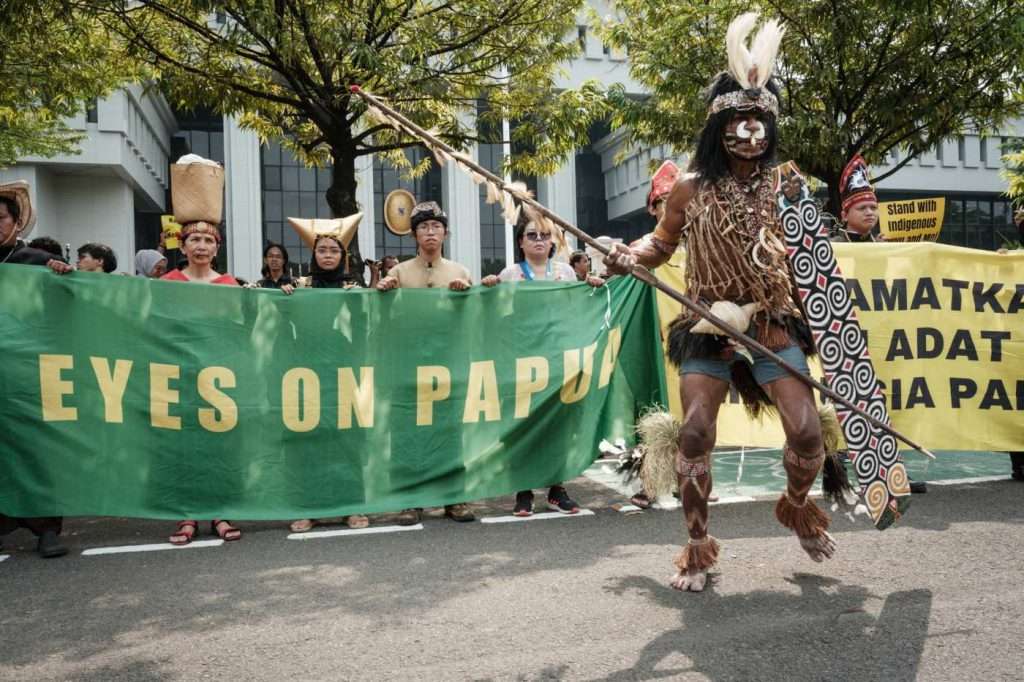
Protests in Jakarta against deforestation and cultivation of palm oil © Yasuyoshi Chiba/AFP/Getty Images
Deforestation in Indonesia’s Papua province is underway and has been carried out with support from the military, but has raised environmental concerns, reported the Financial Times on December 21st.
Indonesia has deployed its military to speed up the clearing of forests in the eastern province for a vast, state‑backed agricultural programme, a move that has alarmed environmentalists, scientists and indigenous communities. The initiative marks a significant escalation in forest conversion in one of the world’s most biodiverse regions.
The government, under President Prabowo Subianto, aims to convert about 3 million hectares of land (an area roughly five times the size of London) into rice and sugarcane plantations. Much of the cleared land is earmarked for sugarcane, which will be used to produce bioethanol, as part of efforts to boost national food and energy security.

Satellite imagery analysed by the Financial Times, shows that more than 40,000 hectares have already been cleared between May 2024 and November 2025, and military personnel are involved in both providing security and operating heavy equipment, according to local residents. “Since the clearing of the forest, the military has been actively involved,” said Ariston Moiwen, whose family land in Merauke has been taken over for rice cultivation. “The military operates the heavy equipment too,” he said.
Environmental groups argue the programme undermines Indonesia’s climate commitments and jeopardises fragile ecosystems. Glenn Hurowitz, chief executive of environmental group Mighty Earth, said, “It’s hard to justify this project from any perspective … environmental, climate and the wellbeing of local communities.”
Papua’s forests, grasslands, woodlands and wetlands are home to rare species including birds of paradise as well as tree kangaroos. Independent researchers warn the land conversion could release hundreds of millions of tonnes of greenhouse gases, potentially far exceeding government estimates. Despite this, the government has revoked “forest area” status for hundreds of thousands of hectares to permit development.
The expansion of military involvement into civilian projects has drawn criticism from indigenous rights advocates. Ambrosius Mulait, a researcher from the indigenous rights group, Pusaka, told the FT that armed troops are present in the fields, “The Indonesian National Armed Forces are working in the field with full weapons … some are holding long firearms. So, when landowners want to protest, they are afraid.”
The defence ministry has defended the decision, stating that military patrols are a standard procedure for securing national strategic projects and are not intended to intimidate communities. Yusuf Jauhari, a defence ministry official, said the presence of personnel around the project “is part of the implementation of territorial development tasks and support for the national food security programme, as mandated by the government”.
Indonesia has attempted similar state-backed agriculture projects before, but they have largely failed. A project on Borneo island was abandoned after clearing swaths of forest, as the soil turned out to be unsuitable for planting rice. Critics pointed to earlier failures where cleared forests proved unsuitable for large‑scale cultivation, and called for alternatives that prioritise productivity improvements on degraded land rather than bulldozing intact ecosystems.
Some experts have said the Papua project will face similar problems. Southern Papua’s wetlands had high acidity, which is not conducive for rice, according to the scientist David Gaveau from The Tree Map, a geospatial company researching deforestation. “If peat soils are present, rice farming will be even more difficult, as their high acidity and low fertility create a harsh environment for crops,” Gaveau said.
Several environmental and indigenous groups have urged for the project to be stopped. “These are carried out without due diligence and consideration of ecological balance, natural resource sustainability and the continuity of intergenerational rights,” said Pusaka executive director Franky Samperante. “They ignore the rights of indigenous communities, simply for the economic benefit of a handful of corporations.”
The controversy comes amid broader concerns over deforestation’s link to climate‑related disasters and recent floods in Sumatra which was blamed in part on forest loss and killed more than 1,000 people. The Papua project’s rapid pace has intensified debate over the balance between development, environmental protection and indigenous rights in Indonesia’s policy making.
Financial Times, Maghrebi.org
Want to chase the pulse of North Africa?
Subscribe to receive our FREE weekly PDF magazine